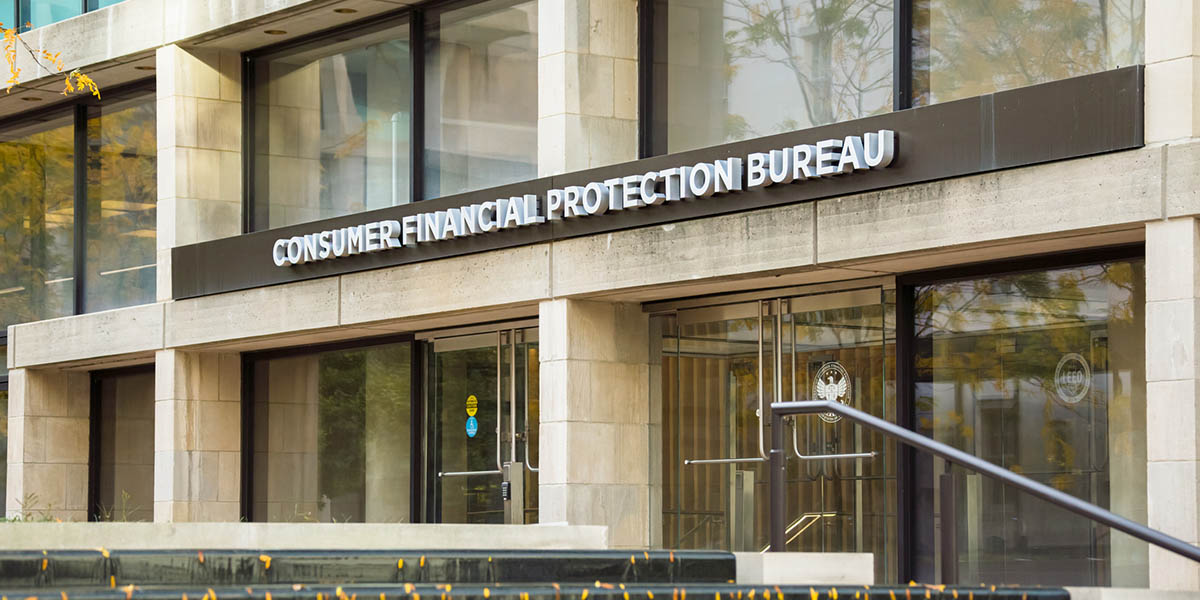
According to a recent report by WebRecon, court filings under the Fair Debt Collection Practices Act (FDCPA) and Fair Credit Reporting Act (FCRA) rose by double digits while litigation under Telephone Consumer Protection Act (TCPA) trended down. Complaints filed with the Consumer Financial Protection Bureau (CFPB) were also down. Yet, everything is up YTD and looks like it will end that way.

In two recent litigation status reports, the Consumer Financial Protection Bureau (CFPB or Bureau) indicated that it is working to issue interim final rules for both Section 1071 and Section 1033 in light of an opinion from the U.S. Department of Justice’s Office of Legal Counsel (OLC) concluding that the Bureau cannot lawfully draw funds from the Federal Reserve Board at this time. Specifically, as discussed here, the OLC concluded that the Federal Reserve System presently has no “combined earnings” from which the CFPB may lawfully draw funds under the Dodd‑Frank Act, and the CFPB has publicly stated it anticipates having sufficient funds to continue normal operations through at least December 31, 2025.

Three nonprofit organizations have filed a complaint in the Northern District of California seeking declaratory and injunctive relief to prevent what they describe as a de facto shutdown of the Consumer Financial Protection Bureau (CFPB or Bureau). Their suit targets Acting Director Russell Vought’s refusal to request funding for the Bureau from the Federal Reserve Board (Fed), arguing that Congress designed a statutory provision that provides stable, standing appropriation to support the CFPB’s mission and that the Director’s recent interpretation of the statute — which is being used to support the refusal to request funding — unlawfully cuts off those funds. The plaintiffs ask the court to compel the CFPB to fulfill its statutory duty by requesting funding immediately.

As reported by Bloomberg, the Democratic Attorneys General Association (DAGA) has hired Rohit Chopra, former Director of the Consumer Financial Protection Bureau (CFPB or Bureau), to lead a new Consumer Protection and Affordability Working Group within DAGA’s policy arm. The move was announced as a coordinated, state-led response to rising living costs and widespread fraud, with a policy agenda that spans financial services, technology, and health care.

Effective September 1, 2025, SB 140 significantly expanded Texas’ telephone solicitation statute. SB 140 expressly covers text messages and similar electronic communications and introduced a direct private right of action under the Texas Deceptive Trade Practices Act (DTPA), with exposure to treble damages, mental‑anguish damages, and attorney’s fees. Recently, a case in the Western District of Texas brought by Ecommerce Marketers Alliance (d/b/a Ecommerce Innovation Alliance), Flux Footwear, and Stodge (d/b/a Postscript) against the State of Texas ended with a joint motion to dismiss after the Texas Attorney General clarified that companies who engage in consent‑based text message programs are not subject to the state’s registration and disclosure requirements. Still, SB 140’s new DTPA cause of action increases the cost of missteps and companies should document affirmative consent.

The Consumer Financial Protection Bureau (CFPB or Bureau) has issued a new proposed rule that would substantially revise the 2023 small business lending data collection and reporting rule under the Equal Credit Opportunity Act (ECOA) and Regulation B, which implements Section 1071 of the Dodd-Frank Act. The proposal re-centers Section 1071 on “core” providers, products, and data, with a single compliance date and material carve-outs to reduce complexity and improve data quality. The proposal is open for comment for 30 days after publication in the Federal Register. However, just this week the CFPB filed a notice with the D.C. Circuit attaching a Department of Justice (DOJ) Office of Legal Counsel (OLC) opinion which concluded that the Bureau will only be legally funded through December 31, potentially affecting rulemaking and operations timelines.

Yesterday, the U.S. Department of Justice (DOJ) notified the U.S. District Court for the District of Columbia and the D.C. Circuit in the matter of National Treasury Employees Union v. Vought that the Consumer Financial Protection Bureau (CFPB or Bureau) anticipates exhausting its currently available funds in early 2026. The filing attaches a November 7 opinion from the Office of Legal Counsel (OLC) to Acting Director Vought concluding that the CFPB’s statutory funding stream — quarterly transfers from the “combined earnings of the Federal Reserve System” under 12 U.S.C. § 5497(a)(1) — is unavailable while the Federal Reserve operates at a loss. The Bureau expects to continue operating, including in compliance with an existing district court injunction, through at least December 31, 2025, but absent congressional action may face a funding lapse thereafter, which would trigger Antideficiency Act constraints.

On October 29, the Consumer Financial Protection Bureau (CFPB or Bureau) officially rescinded its rule requiring nonbank entities to register certain agency and court orders with the Bureau. This decision follows a proposal made earlier this year (discussed here), which highlighted concerns about the regulatory burden and costs imposed on nonbank entities, which could ultimately affect consumers.

On October 28, the Consumer Financial Protection Bureau (CFPB or Bureau) issued a new interpretive rule replacing its 2022 interpretive rule (withdrawn in May 2025) concerning the scope of preemption under the Fair Credit Reporting Act (FCRA). This new interpretive rule clarifies that the FCRA broadly preempts state laws related to consumer reporting, reinforcing Congress’s intent to establish national standards when information is used to determine a consumer’s eligibility for credit, insurance, employment and the like. This move replaces the previous rule, which was criticized for its potential to create regulatory confusion.

On October 10, California Governor Newsom signed Assembly Bill 483 (AB 483) into law, introducing new regulations on early termination fees in fixed term installment contracts. This legislation applies to contracts entered into or modified on or after August 1, 2026, and prohibits the use of termination fees unless specific conditions are met.