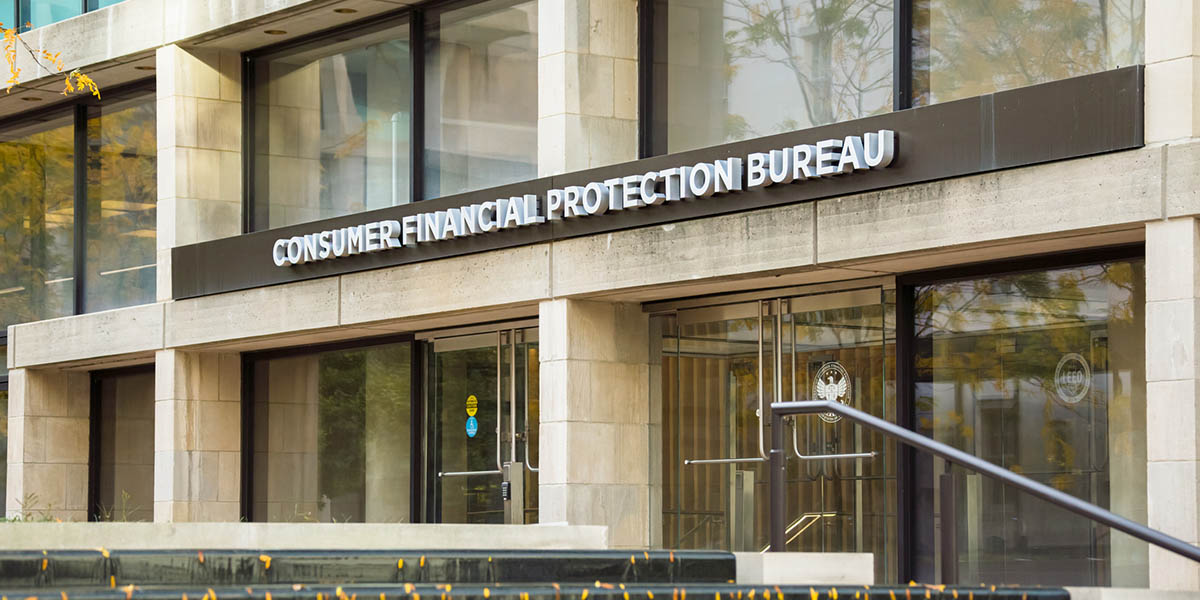
On June 17, the Consumer Financial Protection Bureau (CFPB or Bureau) officially rescinded its December 2020 advisory opinion on special purpose credit programs (SPCPs) under Regulation B, which implements the Equal Credit Opportunity Act (ECOA). The rescission aligns with the Bureau’s recent views on SPCPs, including those expressed in the Bureau’s April 2026 final rule amending the SPCP provisions of Regulation B (the Final Rule) (discussed here).

As we have previously reported, the litigation over the attempted shutdown of the Consumer Financial Protection Bureau (CFPB or Bureau) has continued to move quickly through the courts. By way of background, the D.C. district court had granted a preliminary injunction requiring the CFPB to reverse its shutdown efforts, reinstate its workforce, and continue performing its statutory duties, finding that Acting Director Russell Vought’s actions were inconsistent with the Bureau’s statutory obligations under Title X of the Dodd-Frank Act. In our August 2025 post, we covered the D.C. Circuit panel’s decision vacating that preliminary injunction, holding that most of the National Treasury Employees Union’s (NTEU) claims belonged in the Civil Service Reform Act regime and that the remaining claims did not target reviewable final agency action. In our December 2025 post, we reported on the full court’s decision to grant rehearing en banc, vacate the panel’s judgment, and set an expedited briefing schedule. With the panel decision vacated, the en banc court took up the case with the partial stay continuing to govern the parties’ conduct in the interim.

On June 10, President Trump sent to the Senate his nomination of Brian Johnson to serve as Director of the Consumer Financial Protection Bureau (CFPB or Bureau) for a five-year term. The CFPB has been without a confirmed, full-time director since former Director Rohit Chopra was fired on February 1, 2025 (discussed here).

Federal regulators recently took two coordinated steps that significantly shift expectations for how lenders and banks treat non‑work authorized individuals and their employers. On June 5, the Consumer Financial Protection Bureau (CFPB or Bureau) issued a formal statement on how immigration status should factor into ability‑to‑repay determinations under the Truth in Lending Act (TILA) and Regulation Z. On the same day, the U.S. Department of the Treasury’s Financial Crimes Enforcement Network (FinCEN), jointly with the federal banking agencies and in coordination with the Internal Revenue Service (IRS), released a detailed advisory on fraud, payroll schemes, and money laundering risks associated with the unlawful employment of non-work authorized persons, including specific guidance regarding the use of Individual Taxpayer Identification Numbers (ITINs) and Suspicious Activity Reports (SARs).

On June 4, the Federal Deposit Insurance Corporation (FDIC) filed an amicus brief in the Tenth Circuit’s en banc rehearing of National Association of Industrial Bankers v. Weiser, supporting industry plaintiffs and arguing that the Depository Institutions Deregulation and Monetary Control Act of 1980 (DIDMCA) § 525’s phrase “loans made in such State” refers to the state where the bank is located and performs key lending functions, not where the borrower resides. The filing confirms the FDIC’s historical position on the DIDMCA opt out and directly bears on the limited applicability of Colorado’s opt out and UCCC rate caps.