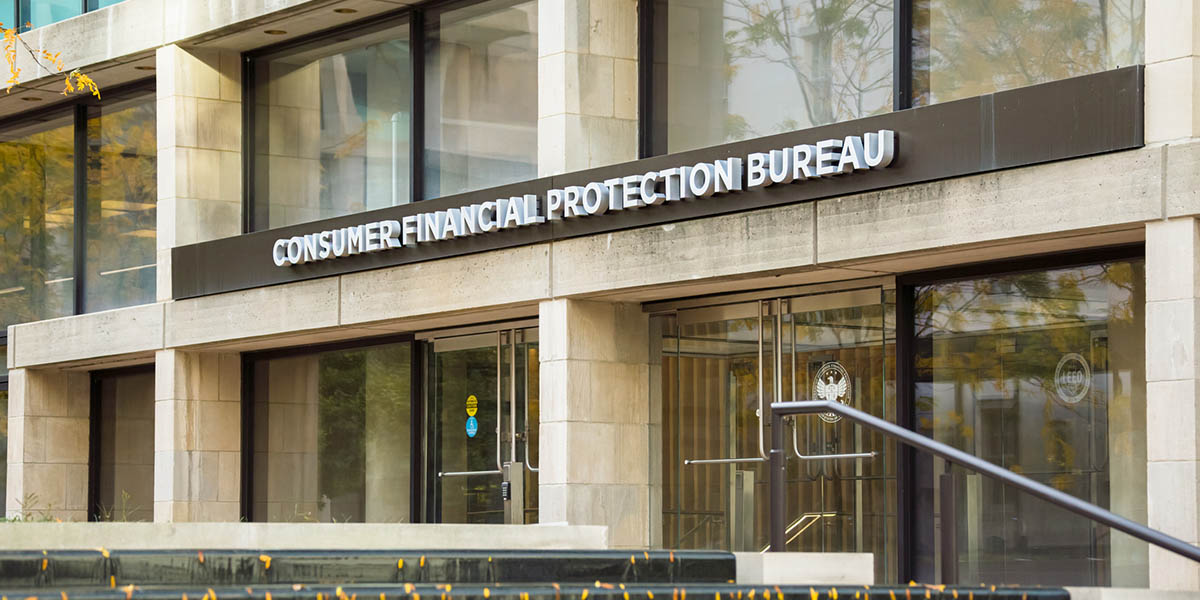
As reported by Bloomberg here, the Consumer Financial Protection Bureau (CFPB or Bureau) is moving to withdraw a 2023 Biden-era joint statement with the U.S. Department of Justice (DOJ) that warned lenders against overbroad use of immigration status in credit decisions. The notice, submitted to the White House’s Office of Information and Regulatory Affairs (OIRA), ties together two hallmark priorities of the current Trump administration: a harder line on immigration and a continued effort to scale back fair lending enforcement. While the underlying Equal Credit Opportunity Act (ECOA) remains unchanged, the move signals a sharp shift in how the CFPB and DOJ are likely to interpret and enforce its protections for noncitizen borrowers.

The Consumer Financial Protection Bureau (CFPB or Bureau) released a new market “data spotlight” on Buy Now, Pay Later (BNPL) that uses actual transaction data from six large providers of “pay-in-four” BNPL loans. The report paints a picture of growing adoption paired with improving credit performance: late fees fell and charge-off rates declined in 2023, even as the number of loans and users rose.

On December 17, New Jersey announced its adoption of what its Attorney General is calling the “most comprehensive state-level disparate impact regulations in the country.” Effective December 15, 2025, the Division on Civil Rights’ (DCR) new rules under the New Jersey Law Against Discrimination (LAD) codify guidance on disparate impact discrimination across housing, lending, employment, places of public accommodation, and contracting.

As we discussed in our prior post on National Treasury Employees Union (NTEU) v. Consumer Financial Protection Bureau (CFPB or Bureau), on August 15 the U.S. Court of Appeals for the District of Columbia issued a decision vacating the district court’s preliminary injunction, which had previously restricted the CFPB’s actions to halt the Bureau’s operations and terminate its employees. The court of appeals held that most of the employees’ claims belonged in the Civil Service Reform Act regime and that the remaining claims did not target reviewable final agency action or equitable claims.

Colorado House Bill 25-1002, effective January 1, 2026, amends Colorado Revised Statutes § 10-16-104(5.5) to require health benefit plans to use nationally recognized, not-for-profit clinical criteria when making coverage and utilization review determinations for behavioral health, mental health, and substance use disorder treatment. The statute establishes a uniform approach to coverage and utilization review and tightens state-level expectations for compliance with the federal Mental Health Parity and Addiction Equity Act (MHPAEA).

On December 11, the White House issued an Executive Order (EO) titled Ensuring a National Policy Framework for Artificial Intelligence (AI). The EO states a federal policy to sustain and enhance U.S. AI leadership through a minimally burdensome national policy framework and to limit conflicting state requirements. It directs rapid actions by multiple federal entities to evaluate, challenge, or preempt state AI laws viewed as inconsistent with that policy and to use federal funding and standard-setting to influence state approaches.

On December 10, the Office of the Comptroller of the Currency (OCC) released preliminary findings from its supervisory review of “debanking” activities at the nine largest national banks. The objective of the review was to determine whether the banks debanked or discriminated against any customers or potential customers on the basis of their political or religious beliefs or lawful business activities. The review, which was required to be completed by the OCC and other federal banking agencies by December 5 pursuant to Executive Order 14331 (Guaranteeing Fair Banking for All Americans), covers the period 2020–2025.

According to a recent report by WebRecon, court filings under the Fair Debt Collection Practices Act (FDCPA) and Fair Credit Reporting Act (FCRA) rose by double digits while litigation under Telephone Consumer Protection Act (TCPA) trended down. Complaints filed with the Consumer Financial Protection Bureau (CFPB) were also down. Yet, everything is up YTD and looks like it will end that way.