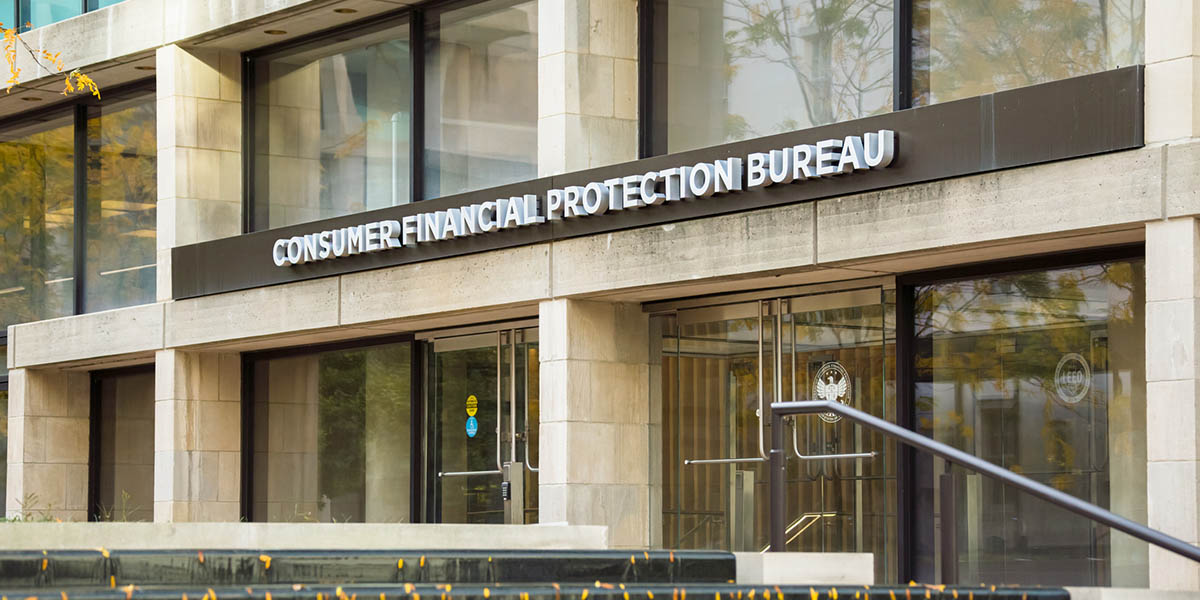
Yesterday, the Consumer Financial Protection Bureau (CFPB or Bureau) released a proposed rule to rescind its previous regulation requiring nonbank entities to report certain agency and court orders to a Bureau registry.
Monitoring the financial services industry to help companies navigate through regulatory compliance, enforcement, and litigation issues
Stefanie takes a holistic approach to working with clients both through compliance counseling and assessment relating to consumer products and services, as well as serving as a zealous advocate in government inquiries, investigations, and consumer litigation.
Yesterday, the Consumer Financial Protection Bureau (CFPB or Bureau) released a proposed rule to rescind its previous regulation requiring nonbank entities to report certain agency and court orders to a Bureau registry.
On May 9, the U.S. Senate Committee on Banking, Housing, and Urban Affairs announced that President Trump signed into law Chairman Tim Scott’s (R-SC) Congressional Review Act (CRA) resolution, effectively overturning the Biden-era Consumer Financial Protection Bureau (CFPB) rule on overdraft fees. Chairman Scott, who spearheaded the effort, emphasized that the rule would have imposed detrimental price controls on overdraft services, potentially leading to more unbanked individuals and fewer consumer options.
Today, the Consumer Financial Protection Bureau (CFPB or Bureau) announced the withdrawal of 67 regulatory guidance documents, including interpretive rules, policy statements, and advisory opinions that have been issued since the Bureau’s inception in 2011. The withdrawn guidance documents impact most federal consumer protection laws, including the Consumer Financial Protection Act of 2010 (CFPA), Fair…
Today, the U.S. Department of the Treasury announced President Trump’s intent to nominate Jonathan McKernan as the Undersecretary of Domestic Finance. The press release states that McKernan’s continued service at Treasury “will ensure that his experience and expertise are best put to advancing the President’s America First agenda.”
Yesterday, the U.S. Court of Appeals for the District of Columbia Circuit issued an order temporarily halting the Consumer Financial Protection Bureau’s (CFPB or Bureau) mass layoffs. The court granted an emergency motion to enforce or clarify its previous order, reinstating the preliminary injunction that prevents the CFPB from executing reductions in force (RIFs).
At an emergency hearing this morning in National Treasury Employees Union v. Vought, Judge Amy Berman Jackson once again halted the layoffs of over 1,000 employees at the Consumer Financial Protection Bureau (CFPB). The judge emphasized the need for a comprehensive record to determine whether the firings complied with the D.C. Circuit’s order from last week (discussed here).
The Consumer Financial Protection Bureau (CFPB or Bureau) is undergoing significant changes as the Trump administration implements sweeping layoffs just days after revising the Bureau’s regulatory priorities. According to reports, approximately 1,400-1,500 employees have received reduction-in-force notices, leaving the CFPB with just over 200 personnel to carry out its regulatory activities. This drastic reduction raises critical questions about the agency’s ability to effectively focus on its newly outlined priorities for 2025.
This article was republished on insideARM on April 22, 2025.
Yesterday, the Consumer Financial Protection Bureau (CFPB or Bureau) released a memo to staff outlining its new supervision and enforcement priorities for 2025.
The Consumer Financial Protection Bureau (CFPB or Bureau) agreed to vacate its controversial credit card late fee rule in a joint motion for entry of consent judgment filed in Chamber of Commerce of the United States of America v. CFPB yesterday. This significant move comes after the U.S. District Court for the Northern District of Texas found that the rule likely violated the Credit Card Accountability and Disclosure Act (CARD Act). The consent judgment marks a pivotal resolution in the case, with the CFPB acknowledging that the rule failed to allow card issuers to impose penalty fees that are “reasonable and proportional” to violations, as required by the CARD Act.
On April 11, the U.S. Court of Appeals for the District of Columbia Circuit issued an order partially staying the district court’s preliminary injunction in the ongoing legal dispute between the National Treasury Employees Union (NTEU) and the Consumer Financial Protection Bureau (CFPB). This decision marks a significant development in the NTEU’s challenge against Acting Director Russell Vought’s actions, which the union claims are unconstitutional and violate the Dodd-Frank Act. The appellate court’s order addresses several key provisions of the district court’s injunction, setting the stage for an expedited appeal process.
In addition to cookies that are necessary for website operation, this website uses cookies and other tracking tools for various purposes, including to provide enhanced functionality and measure website performance. To learn more about our information practices, please visit our Privacy Notice.