To keep you informed of recent activities, below are several of the most significant federal and state events that have influenced the Consumer Financial Services industry over the past week.


To keep you informed of recent activities, below are several of the most significant federal and state events that have influenced the Consumer Financial Services industry over the past week.

On December 10, the Office of the Comptroller of the Currency (OCC) released preliminary findings from its supervisory review of “debanking” activities at the nine largest national banks. The objective of the review was to determine whether the banks debanked or discriminated against any customers or potential customers on the basis of their political or religious beliefs or lawful business activities. The review, which was required to be completed by the OCC and other federal banking agencies by December 5 pursuant to Executive Order 14331 (Guaranteeing Fair Banking for All Americans), covers the period 2020–2025.

In two recent litigation status reports, the Consumer Financial Protection Bureau (CFPB or Bureau) indicated that it is working to issue interim final rules for both Section 1071 and Section 1033 in light of an opinion from the U.S. Department of Justice’s Office of Legal Counsel (OLC) concluding that the Bureau cannot lawfully draw funds from the Federal Reserve Board at this time. Specifically, as discussed here, the OLC concluded that the Federal Reserve System presently has no “combined earnings” from which the CFPB may lawfully draw funds under the Dodd‑Frank Act, and the CFPB has publicly stated it anticipates having sufficient funds to continue normal operations through at least December 31, 2025.
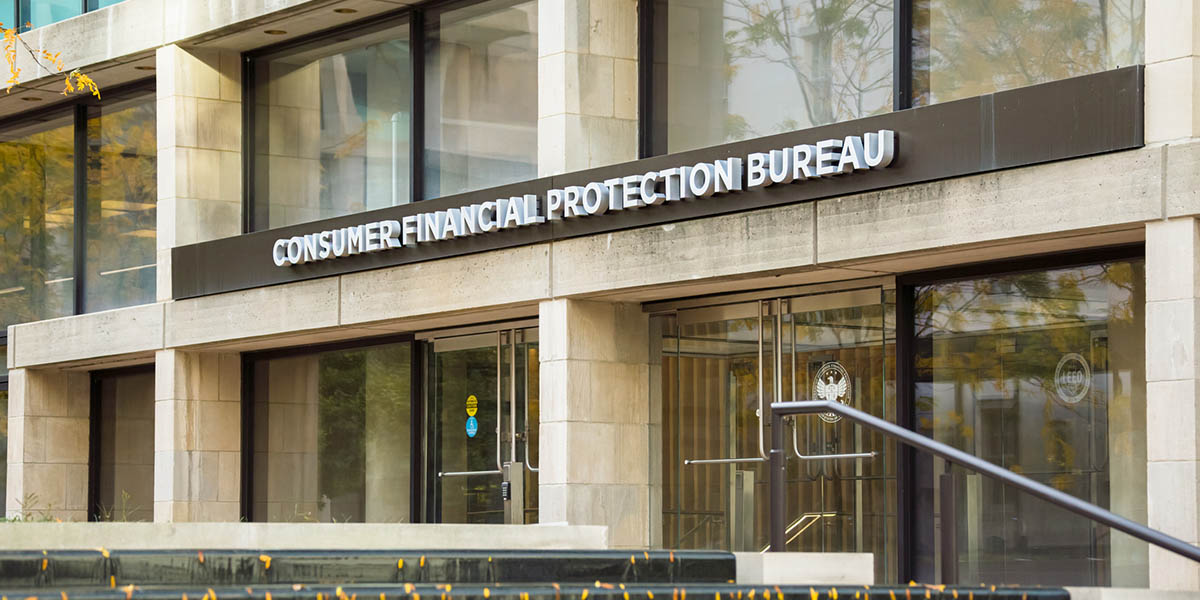
Three nonprofit organizations have filed a complaint in the Northern District of California seeking declaratory and injunctive relief to prevent what they describe as a de facto shutdown of the Consumer Financial Protection Bureau (CFPB or Bureau). Their suit targets Acting Director Russell Vought’s refusal to request funding for the Bureau from the Federal Reserve Board (Fed), arguing that Congress designed a statutory provision that provides stable, standing appropriation to support the CFPB’s mission and that the Director’s recent interpretation of the statute — which is being used to support the refusal to request funding — unlawfully cuts off those funds. The plaintiffs ask the court to compel the CFPB to fulfill its statutory duty by requesting funding immediately.
To keep you informed of recent activities, below are several of the most significant federal and state events that have influenced the Consumer Financial Services industry over the past week.

On November 25, the House Financial Services Committee majority staff published Operation Chokepoint 2.0: Biden’s Debanking of Digital Assets, a detailed account of how, in the Committee’s view, federal prudential regulators between 2021 and early 2025 discouraged banks from serving lawful digital asset businesses through informal guidance, supervisory posture, and enforcement.

As reported by Bloomberg, the Democratic Attorneys General Association (DAGA) has hired Rohit Chopra, former Director of the Consumer Financial Protection Bureau (CFPB or Bureau), to lead a new Consumer Protection and Affordability Working Group within DAGA’s policy arm. The move was announced as a coordinated, state-led response to rising living costs and widespread fraud, with a policy agenda that spans financial services, technology, and health care.
To keep you informed of recent activities, below are several of the most significant federal and state events that have influenced the Consumer Financial Services industry over the past week.
To keep you informed of recent activities, below are several of the most significant federal and state events that have influenced the Consumer Financial Services industry over the past week.

As reported by Law360 on November 20, the Consumer Financial Protection Bureau (CFPB or Bureau) will hand off its remaining enforcement lawsuits and other active litigation to the U.S. Department of Justice (DOJ) as the Bureau prepares for a potential funding lapse. CFPB staff were informed that DOJ will begin assuming matters from the CFPB’s enforcement and legal divisions in the coming weeks, with transfer logistics to be worked out. It remains unclear whether all pending cases will survive the transition or whether case schedules and continuity will be affected.