
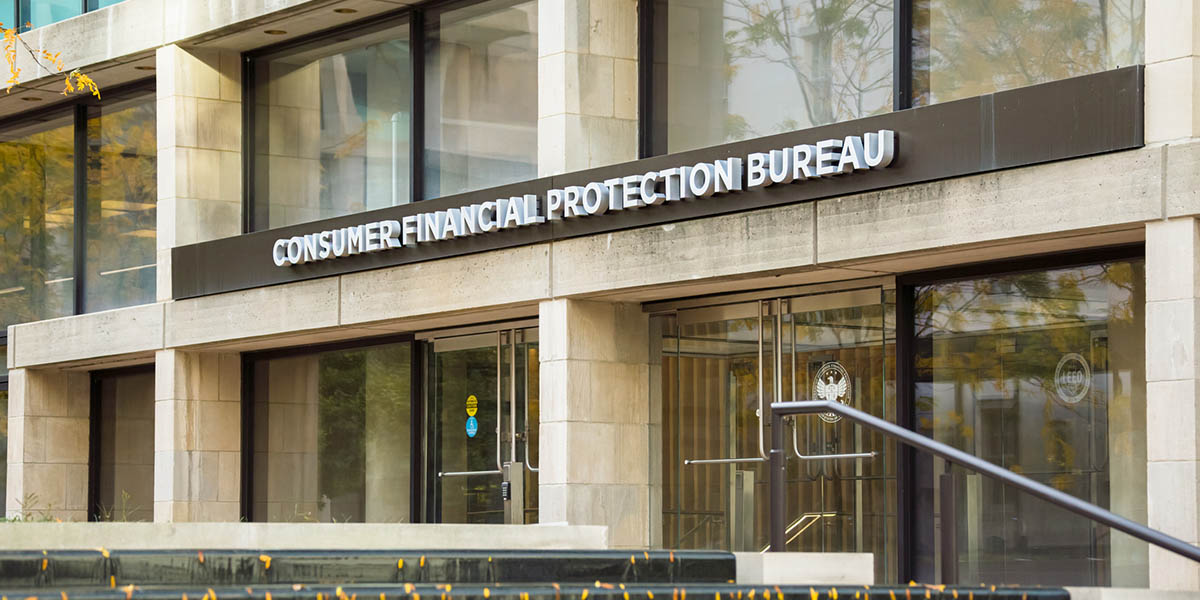
On May 27, the National Fair Housing Alliance (NFHA), Rise Economy (formerly known as the California Reinvestment Coalition), and two fair lending compliance companies (BLDS, LLC, and SolasAI) filed suit in the U.S. District Court for the District of Columbia challenging the Consumer Financial Protection Bureau’s (CFPB or Bureau) Regulation B (Subpart A) final rule, which implements the Equal Credit Opportunity Act (ECOA), and was issued on April 22, 2026. The case, National Fair Housing Alliance et al. v. CFPB et al., is notable not only for challenging the CFPB’s significant rewrite of longstanding Reg B, but also because the NFHA and Rise Economy are the first consumer advocacy organizations to sue the CFPB over the final rule.
Three Key Changes to Regulation B
The April 22, 2026 final rule (discussed here) marks the most significant revision of Reg B since ECOA’s enactment in 1974. The final rule made three dramatic changes to Reg B:
- The CFPB declared that ECOA does not support disparate‑impact liability and removed the “effects test” language from Reg B that had treated facially neutral policies with unjustified disparate effects as actionable under ECOA.
- Second, the Bureau narrowed the prohibition on discouraging prospective applicants. Where Reg B had previously reached “acts or practices” (such as branch locations and marketing efforts) that could discourage a reasonable person from applying on a prohibited basis, the new rule confines discouragement to “spoken or written words, or visual images” that a creditor knows or should know would lead a reasonable person to believe the person will be denied or receive worse terms because of a protected characteristic.
- Third, the rule refashions the special purpose credit program (SPCP) provisions for-profit institutions by eliminating SPCPs that use race, color, national origin, or sex as eligibility criteria and imposing new conditions on SPCPs that use other prohibited bases (such as religion, marital status, age, and public assistance income) as eligibility criteria.
According to the plaintiffs, these changes reverse decades of consistent agency and interagency guidance and create a different fair‑lending landscape under ECOA than under the Fair Housing Act (FHA), which the U.S. Supreme Court has interpreted to accommodate disparate‑impact claims.
The Complaint
The plaintiffs seek declaratory and injunctive relief under the Administrative Procedure Act, asking the court to vacate the final rule as arbitrary and capricious, contrary to ECOA, procedurally defective, beyond the CFPB’s authority, and invalid because actions taken under Acting Director Russell Vought were beyond the scope of his authority.
On disparate impact, they argue that the CFPB’s reversal cannot be squared with ECOA’s “on the basis of” language, legislative history incorporating the U.S. Supreme Court’s Griggs “effects test,” and decades of agency interpretations recognizing disparate impact under ECOA. They stress that Congress twice declined to amend ECOA to require intentional discrimination, and contend that the Bureau dismissed this history and related reliance interests by merely asserting that its new reading is “the best” interpretation without properly considering ECOA’s statutory purpose, legislative history, and contrary precedent.
On discouragement, the complaint challenges the narrowing of Reg B from “acts or practices” to a limited set of statements and the exclusion of branch siting, marketing, and other pre‑application conduct. The plaintiffs contend that these revisions invite redlining and “digital redlining” by allowing creditors to structure advertising and branch locations to deter applications from protected classes, even with discriminatory intent. They also contest the creation of categorical “safe harbors” for facially neutral statements, arguing that whether these statements are in reality discriminatory “code-words” or “dog-whistles” should be decided on a case-by-case basis by courts and juries, not foreclosed by regulatory commentary.
Regarding SPCPs, the plaintiffs assert that the final rule conflicts with ECOA’s text, which authorizes for‑profit SPCPs “to meet special social needs” without carving out race, color, national origin, or sex. They claim that the combined ban on race‑ and sex‑based SPCPs and the requirement that each participant be demonstrably uncreditworthy outside of the program effectively nullify the statute, and that the Bureau’s reliance on its “adjustment authority” impermissibly eliminates a congressionally created program category.
The complaint further attacks the Bureau’s Dodd‑Frank § 1022(b) cost‑benefit analysis and compliance with the Regulatory Flexibility Act, as amended by the Small Business Regulatory Enforcement Fairness Act (SBREFA), characterizing the discussion of benefits as speculative and the treatment of costs, such as reduced credit access, heightened discrimination risk, and conflicting ECOA/FHA regimes, as cursory. The plaintiffs allege that the CFPB failed to prepare required regulatory flexibility analyses, did not convene an SBREFA panel, and improperly certified that the rule would not significantly impact small businesses. Finally, they argue that Vought was unlawfully appointed as Acting Director of the CFPB under the Federal Vacancies Reform Act because Director Chopra was removed rather than unable to perform his duties, resulting in the final rule being void because, without a lawful Director, the CFPB is not permitted to engage in rulemaking activities.
Our Take
As we predicted, consumer advocacy groups have quickly challenged the CFPB’s sweeping changes to Reg B, and it is likely that litigation may tie up implementation of the final rule for months if not years. If the plaintiffs succeed, the court could vacate the Reg B final rule, reinstating the prior disparate‑impact, discouragement, and SPCP framework and injecting additional uncertainty into ECOA compliance. Even if the rule ultimately stands, the litigation highlights the tension between the CFPB’s new approach and longstanding interpretations by other federal regulators and courts, especially concerning whether disparate impact claims are cognizable under ECOA. We will continue to monitor this litigation and provide periodic updates.